
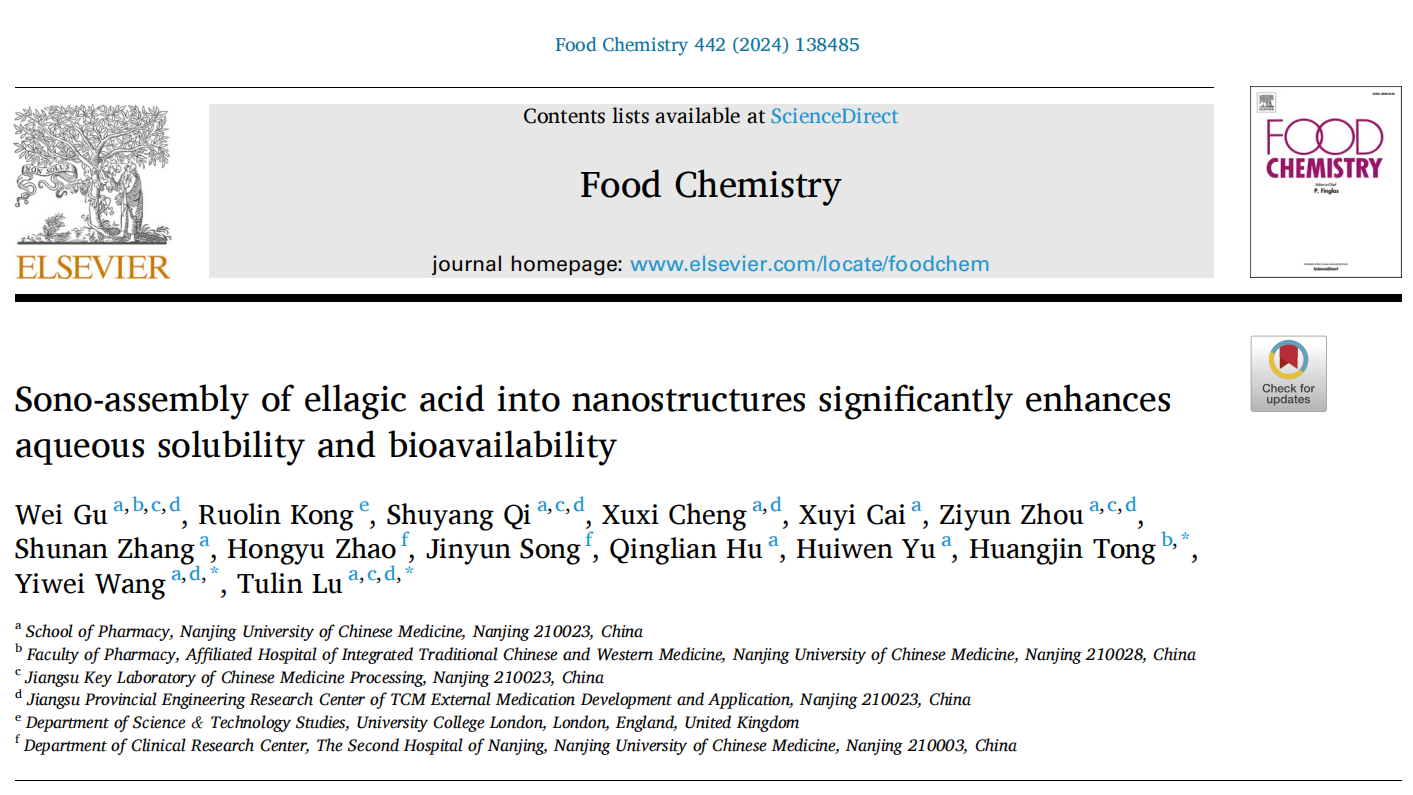
Prof. Wei Gu's team at Nanjing University of Chinese Medicine published a research paper in the international authoritative journal Food Chemistry (CAS Zone 1, IF 8.5), titled:
Sono‑assembly of Ellagic Acid into Nanostructures Significantly Enhances Aqueous Solubility and Bioavailability
This research provides the scientific foundation for NanYan XinSi's core technology: ellagic acid supramolecular nano-encapsulation. Detailed analysis follows.
I. Research Background: Ellagic acid is beneficial, but it suffers from poor solubility and low bioavailability.
Ellagic acid is widely found in fruits such as pomegranate, raspberry, and strawberry, offering multiple health benefits including antioxidant, anti-inflammatory, and cardiovascular protective effects. However, its extremely low water solubility (<10 μg/mL) and poor oral bioavailability of less than 1% significantly limit its application in food, dietary supplements, and skincare products.
Traditional solutions often require excessive excipients or complex processes, resulting in high costs, low drug loading, and limited efficacy. Developing a green and efficient method to enhance ellagic acid's water solubility and bioavailability remains a critical challenge for both academia and industry.
II. Technical Breakthrough: Ultrasound-Driven Self-Assembly of Ellagic Acid Nanoparticles
The Wei Gu team used sonoassembly technology to prepare ellagic acid nanoparticles (EA NPs) without adding any carriers or surfactants.
Key Process Parameters:
Ellagic acid concentration: 20 mg/mL
Ultrasound Temperature: 45°C
Ultrasound time: 30 min (cleaner) + 2 min (probe)
Centrifuge to collect the supernatant, then lyophilize to obtain a powder.
Structure Representation Results:
The nanoparticles are rod-shaped, with an average diameter of 147.3 ± 0.73 nm and a uniform distribution (PDI ≈ 0.2).
Zeta potential is approximately 42 mV, indicating a strongly negative surface charge that promotes stable dispersion in aqueous solution (7-day stability).
Lyophilized powder is a loose, porous, sponge-like material with a large specific surface area, facilitating rapid dissolution.
III. Major Progress: Solubility increased 120-fold, bioavailability improved 4.69-fold
1. Balanced Solubility
Solvent / Conditions | Free Ellagic Acid | Ellagic acid nanoparticles | Boost Factor |
Water | 5.86 μg/mL | 707.34 μg/mL | 120.7x |
pH 6.8 Buffer | 5.60 μg/mL | 547.71 μg/mL | 97.8x |
Methanol | — | — | 2.5x |
n-Octanol | No significant difference | No significant difference | No significant change |
These results indicate that ultrasonic assembly significantly enhances ellagic acid's water solubility without altering its lipid solubility, which is crucial for both transdermal and oral absorption.
2. Ex vivo intestinal permeability assay
In the rat intestinal model, the cumulative permeation of ellagic acid nanoparticles was significantly higher than that of free ellagic acid (P < 0.05), indicating enhanced ability to cross the intestinal barrier after nanoformulation.
3. Pharmacokinetics in Rats
After oral administration, the area under the plasma concentration-time curve (AUC₀₋∞) for the ellagic acid nanoparticle group increased from 0.329 to 1.543 μg·h·mL⁻¹, with a 4.69-fold improvement in relative bioavailability. The time to reach maximum concentration (Tmax) was significantly delayed, indicating that the nanoparticles exhibit sustained-release properties and can extend the duration of action.
4. Mechanism Analysis: Ellagic Acid Nanoparticles Are a Novel Tunnel-Type Hydrate
The research team used multiple analytical techniques (MS, FTIR, XRD, TGDSC, and elemental analysis) to thoroughly characterize the structure of the nanoparticles:
Composition Analysis:The ellagic acid (EA) content in EA-loaded nanoparticles is approximately 80%, water content is approximately 20%, and the molar ratio of EA : H₂O is approximately 1 : 4.
Infrared Spectroscopy:The hydroxyl peak of ellagic acid at 3475 cm⁻¹ disappeared, indicating that intramolecular hydrogen bonds were disrupted during sonication and that EA formed new intermolecular hydrogen bonds with four water molecules. Thermal analysis: TGDSC showed that the dehydration temperature of ellagic acid nanoparticles was below 100°C, accompanied by a slow, continuous weight loss. This suggests the formation of a tunnel-type solvate structure where water molecules can enter the crystal lattice tunnels and bind specifically to EA molecules.
Powder Diffraction:Some diffraction peaks are retained while others change, indicating that the crystal structure has adjusted after nano-sizing but has not become fully amorphous.
This structural feature is the fundamental reason for the significant increase in solubility.
5. Advantages Over Existing Technology
Over the past two decades, scientists have explored multiple approaches—including cyclodextrin complexation, lipid nanoparticles, and self-emulsifying systems—to enhance ellagic acid solubility. However, most methods require large amounts of excipients, involve complex preparation processes, offer low drug loading, and typically achieve less than 30-fold improvement in solubility and less than 3.6-fold improvement in bioavailability.
Unique advantages of the Gu Wei team's approach:
✅ No additives: Only ellagic acid and water. Eco-friendly and green.
✅ Simple Process: Ultrasonication + Centrifugation + Freeze-drying; Easy to Scale Up
✅ High Drug Loading: Ellagic acid content in the product reaches 80%
✅ 120x Solubility Boost: Among the highest levels achieved by known physical modification methods
✅ 4.69x higher bioavailability: significantly enhanced in-body effectiveness
✅ Dual potential for oral and topical use: Nanoparticles enhance transdermal absorption, providing a technical foundation for topical formulations (e.g., Nanyan Xinsi Scalp Serum).
VI. Direct Significance to NanYan New Silk Products
The core technology of NanYan XinSi Ellagic Acid Scalp Serum Foam is based on the aforementioned research findings from Professor Gu Wei's team:
Supramolecular Nanonization: Using ultrasonic self-assembly to convert ellagic acid into nanoparticles, overcoming its extremely low water solubility and enabling effective scalp penetration.
Up to 120× increase in solubility: ensures high concentration of active ingredients in foam formulations for true "delivery and effectiveness."
Gentle & Additive-Free: No chemical solvents or surfactants used for a safer, milder experience.
Patent Protection: This technology is covered by a national invention patent (ZL202211465349.3), forming a solid technical barrier.
Without this foundational research, the Nanyan New Silk foam serum that now provides stable, efficient, and gentle scalp care would not exist.
VII. Conclusion
Prof. Wei Gu's team has not only overcome solubility barriers for ellagic acid in food and dietary supplements but also provided a reliable technical foundation for topical scalp care products. Nan Yan Xin Si, the commercialized outcome of this technology, exemplifies the successful journey "from lab to market."
In the future, our team will continue to advance ellagic acid nanotechnology and expand its applications to a wider range of scalp and skin health concerns, bringing science to everyday life.
Bibliographic Information
Title: Sonoassembly of Ellagic Acid into Nanostructures Significantly Enhances Aqueous Solubility and Bioavailability
Authors: Gu W, Kong R, Qi S, et al.
Journal: Food Chemistry, 2024, 442: 138485
DOI: 10.1016/j.foodchem.2024.138485